All Quasar's have black holes for hearts - but that doesn't mean they are unfriendly. In fact, 9 billion light year distant QSO2237+0305 may like us so much that it wants to make sure we see it even though it is actually hidden by a much nearer spiral galaxy. What can we learn from QSO2237+0305? For one, the cross that bears Einstein's name can tell us a lot about space-time curvature. For another, it can teach us invaluable lessons about how to see things otherwise hidden from view. If you have access to the scope and the skies, you too can see what the whole spectacle is all about.
Continue reading
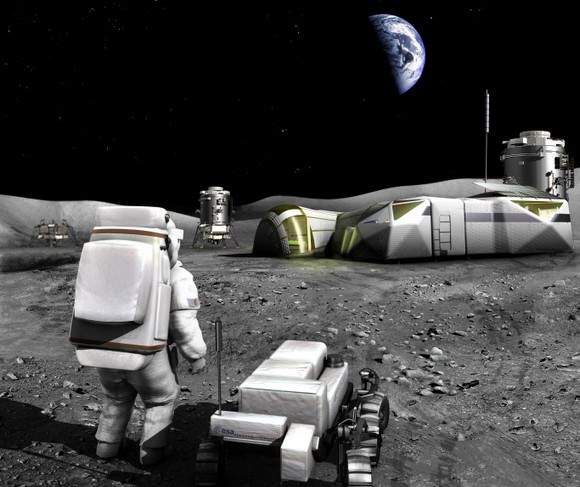
As part of its new Vision for Space Exploration, NASA will first be returning to the Moon before sending human explorers to Mars. Although Mars is a much more Earth like environment, with an atmosphere, similar length of day and large amounts of water, the Moon is going to be the agency's first target. Why? Mainly, it's much closer, so astronauts can practice working in an extreme environment close to home before making the much more difficult and riskier journey to Mars.
Continue reading
Officials from the European Space Agency and Indian Space Research Organisation have approved on a cooperative project to send a spacecraft to the Moon. ISRO will launch Chandrayaan-1 in 2007/2008 to analyze the Moon to help understand its origin and evolution. Europe will provide three scientific instruments identical to ones on SMART-1, which is currently orbiting the Moon.
Continue reading
NASA's Cassini spacecraft was recently in a lucky position in space earlier this month to watch its own private lunar eclipse, as one of Saturn's moons (Mimas) passed in front of another (Janus). Cassini's camera was rolling the whole time, and the spacecraft captured 37 images that have been stitched together into a movie of the event. Some large terrain is visible on Mimas, including its gigantic crater (the one that makes it look like the Death Star from Star Wars).
Continue reading
An international team of astrophysicists have developed a new theory to explain the accelerating expansion of the Universe, known as "dark energy". Instead of a mysterious energy which is pushing matter apart at an accelerating rate, the team believes it could be the natural outcome of ripples in space and time created during the earliest moments of inflation after the Big Bang. These ripples could extend beyond what we can see with our telescopes, so we can only calculate their existence.
Continue reading
During its many months orbiting Saturn, Cassini has gotten a few good looks at Hyperion, one of the planets many moons. This irregularly shaped moon is reasonably large (266 km or 165 miles across) and chaotically tumbles in its orbit around Saturn. Cassini took these images in October 2004 and February 2005 at relatively similar distances. It will get a much better view in September, 2005, when the spacecraft is scheduled to make a flyby at an altitude of only 990 km (615 miles).
Continue reading
Researchers have discovered evidence of recent glacier movements and volcanic eruptions on Mars, overturning the long-held opinion that it's a cold, dead world. As recently as 350,000 years ago, glaciers moved from Mars' poles to its tropics, covering the planet in sheets of ice. And several of Mars' giant volcanoes were active as recently as 2 million years ago. The heat from these volcanoes could sustain microbial life in underground pools of liquid water.
Continue reading
An instrument on board the Mars Exploration rover Opportunity is malfunctioning, so mission controllers have decided to turn it off until they can figure out what's causing the problem. The problem is with its miniature thermal emission spectrometer (Mini-TES), which Opportunity uses to sense the mineral composition of distant rocks. The problem could be with a broken switch that helps position the mirror that directs infrared light into the Mini-TES. Even if engineers can't figure out a solution, Opportunity can still return some science with the instrument partially functioning.
Continue reading
Astronomers have known since 1998 that a mysterious force seems to be accelerating the expansion of the Universe. An international team of astronomers have observations from Hubble and a powerful computer simulation to find evidence of dark energy much closer to home. The team studied the motion of our local group of galaxies (40 galaxies within 5 million light years) and found that you could only explain their current positions if you include the influence of dark energy.
Continue reading
NASA's Cassini spacecraft has made a surprising discovery about Saturn's moon Enceladus: it has an atmosphere of water vapour. Cassini detected the atmosphere during both of its recent close flybys. Scientists are sure what's causing this cloud of water vapour, but it could be caused by volcanoes, geysers, or gasses escaping from the moon's interior. Enceladus' gravity is very small, so it wouldn't be able to hold onto an atmosphere for very long. This means there must be some continuous source replenishing it.
Continue reading
A hardy robot from Carnegie Mellon has found life in Chile's Atacama desert; one of the driest and most lifeless places on Earth. Life is barely detectable over most parts of Atacama, but the rover (named Zo?) was able to detect lichens and bacterial colonies in two regions that it explored. The solar-powered rover provides a good example of the kind of technology that will probably used to search for life on Mars. Next year Zo? will travel autonomously for two months, traveling 50 km in the search for life.
Continue reading
European astronomers have found a group of stars in the Omega Centauri globular cluster which seem to be some of the most rich in helium ever seen. These are bluer stars, and astronomers would expect that they contained lighter elements, but the team found exactly the opposite - they have more heavy elements than red stars. One theory to explain this is that previous generations of stars exploded as supernovae, and seeded the region with helium and heavier elements. These blue stars then formed from this material.
Continue reading
Greetings, fellow SkyWatchers! While the Moon will figure prominently in this week's scheme, there will be many occultations to view as well as lunar features. We'll return to visit both the M50 and M44, as well as learn about double star - Algieba There are two minor meteor showers and planets to explore. So grab your binoculars and telescopes, because...
Here's what's up!
Continue reading
NASA's Spirit rover has been fortunate enough this week to spot a tiny dust devil scurrying across the surface of Mars. The various orbiters have seen crisscrossing dust devil tracks, but this is the first time one has been captured on camera from the surface. It also appears that Spirit was recently dusted off by one of these mini-twisters, cleaning off accumulations of dust, and boosting its available power for operations. This also happened a few months ago to Spirit's twin, Opportunity.
Continue reading
Continue reading
A powerful Atlas V rocket lifted off from Cape Canavaral on Friday, carrying its heaviest cargo to date: the 5,959 kg (13,138 pound) Inmarsat 4-F1 satellite. The rocket had three additional solid boosters to help it carry this weight into orbit. The launch was delayed one day because of technical problems, but the launch itself went smoothly in good weather. The satellite will be used by Inmarsat to provide voice and data communication services.
Continue reading
Thanks to data collected by NASA's WMAP probe in 2001 and 2002, plus the hard work of astrophysicists, we now know that the Universe is 13.7 billion years of age - give or take a few hundred million years. And thanks to the way distant galaxy clusters interacted with the cosmic microwave background radiation (CMBR) some 7 billion years ago, we may soon be able to peel away layers of time and better understand irregularities in the shape of the universe as it is today.
Continue reading
Amateur photographer Bojan Stajcar took this picture of the lunar occulation of Jupiter on the 27th of February. This picture was taken 10 minutes after the Moon partially occulted Jupiter, at 11:04 pm local time, from Melbourne, Australia. The camera used was a mechanically modified Connectix Quickcam, with 320x240 pixel CCD sensor in the focus of the motorized ("Bartelized") homemade 10", f5.6 reflector. Note the difference in the surfaces brightness of the Moon and Jupiter. Despite the fact that the moon surface consists of very low reflective material (dominantly basalt), it is brighter, as Jupiter is 5 times further away from the Sun.
Continue reading
Scientists are in agreement that a rock from space smashed into the ground in Arizona 50,000 years ago, carving out a pit 1,250 metres (4,100 feet) across. But they're now starting to disagree on the speed the asteroid was going when it hit. One mystery that has been puzzling scientists: where is all the impact-melted rock? If it was going as much as 20 km/s (44,000 mph) as originally believed, it should have fractured into pieces which would have rained down over a larger area. But a new simulation calculates that it was going only half that speed, and probably came down as a swarm of material, not a single rock.
Continue reading
New observations from the Hubble Space Telescope are helping astronomers fine tune their models of star formation, including an estimate of just how massive a star can become. Hubble carefully observed the Arches cluster, a group of stars collectively weighing 10,000 solar masses. Standard theories predicted 20 to 30 stars in the cluster would have 150 solar masses, but none turned up; although, at least a dozen push 100 solar masses. What variables could limit the amount of mass a star can pack on?
Continue reading
 Universe Today