We only see material in the Universe when it's hot enough to glow, like stars, hot clouds of gas or galaxies. The material which isn't glowing is practically invisible. But astronomers from the Harvard Smithsonian Center for Astrophysics have developed a method to detect the reflected starlight bouncing off of normally dark clouds of material. This "cloudshine" allows astronomers to see the shape of a cloud forming nebula in tremendous detail.
Continue reading
Astronomers have used the National Science Foundation's continent-wide Very Long Baseline Array (VLBA), to peer deeper into the heart of the Milky Way than ever before. This image brings astronomers tantalizingly close the supermassive black hole believed to lurk there called Sagittarius A*. The strong pull of this black hole should create a distinctive shadow on the surrounding material, which should be visible if astronomers can double the sensitivity of this instrument.
Continue reading
NASA's Spitzer Space Telescope might have captured images of the first stars in the Universe, glimpsing an era more than 13 billion years ago; a time when the glow of the Big Bang faded. A 10-hour observation by Spitzer's infrared camera array in the constellation Draco captured a diffuse glow of infrared light. It's believed this glow is coming from the first stars, more than a hundred times more massive than our Sun, which survived for only a few million years before exploding as the first supernovae.
Continue reading
Researchers have discovered methane-producing microbes in some of the most inhospitable deserts here in Earth, bolstering the theory that methane detected in the Martian atmosphere was caused by life. The scientists collected soil samples near the Mars Desert Research Station in the Utah desert. They added a growth medium to the soil, and detected methane gas being released. This isn't conclusive evidence of life on Mars, but it helps make the case that microbial life can and might exist on the Martian surface.
Continue reading
Astronomers were expecting that a massive star in the Westerlund 1 star cluster should have collapsed into a black hole. Instead, it became a neutron star. Since this star was 40 times the mass of the Sun before it collapsed, it should have been a prime black hole candidate. So why did it end up as a neutron star? It's possible that the star blew off most of its mass at the end of its life, so there just wasn't enough material to form a black hole.
Continue reading
When Mars Express' Planetary Fourier Spectrometer (PFS) malfunctioned a few months ago, mission controllers weren't sure they could get it working again. Well, they were wrong. It turns out that the pendulum motor, which drives various parts of the PFS had failed, and they were able to recover by using a back-up motor. PFS is a very sensitive instrument capable of detecting minute traces of various gasses in the Martian atmosphere, including methane which could indicate current life on the Red Planet.
Continue reading
During Cassini's recent Titan flyby on October 28, 2005, it imaged the area where Huygens landed earlier this year. Of course it couldn't see the probe, but scientists were able to match up Cassini's images to Huygen's images to show exactly where it landed. The colour image is was actually taken in infrared (red areas are brighter and blue is darker, and the the black-and-white image was produced by Cassini's synthetic aperture radar.
Continue reading
Eta Carinae is one of the most massive and unusual stars in the Milky Way, and now NASA's Far Ultraviolet Spectroscopic Explorer satellite has detected a hot companion. This mysterious star, which scientists think is in the final stages of life, is located 7,500 light-years from Earth in the constellation Carina. Its companion star completes an orbit every 5.5 years, and FUSE was able to detect when it passed behind Eta Carinae, briefly dimming the amount of high-end ultraviolet radiation coming from the pair.
Continue reading
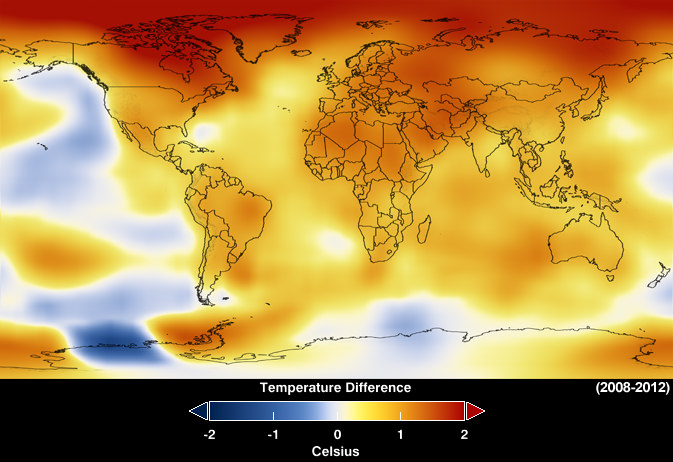
Scientists at the Lawrence Livermore National Laboratory have developed a detailed model of the Earth's climate over the next few centuries to answer the question... what if we burned all the fossil fuels by the year 2300. The answer, of course, isn't a pretty picture. In their model, global temperatures will rise 8-degrees Celsius (14.5 F), and melting polar caps will raise the oceans 7 metres (23 feet). The damage would be even worse in the polar regions, which could grow by 20-degrees C (68 F).
Continue reading
This photograph of Saturn's moon Dione was taken by Cassini on Sept. 20, 2005 from a distance of 2.1 million kilometers (1.3 million miles). The image shows the many canyons that crisscross the surface of the 1,126-kilometer (700-mile) moon, as well as its bright southern pole.
Continue reading
Time to revise your idea of Pluto. New images gathered by the Hubble Space Telescope have revealed that this distant planet could two additional moons. If this is true, Pluto will be the first Kuiper Belt Object found to have multiple moons. The candidate moons have been provisionally named S/2005 P1 and S/2005 P2, and are approximately 44,000 km (27,000 miles) away from Pluto.
Continue reading
Is science fiction an arena where fantasies run wild or an experimental lab where new technologies, cultures and even physics can be assessed? Afficionados of this genre more likely think the latter. But not long ago, science fiction stories and even rocketry were considered little more than a fool's occupation. One person bucked this trend. He is Jack Parsons and he is also the central figure in George Pendle's biography entitled
Strange Angel. From this we read how Parsons made believers of many people who ridiculed science and space travel.
Greetings, fellow SkyWatchers! We begin the week on the eve of All Hallows as we learn the significance the Pleiades. Come... Join in the fun as we as the night steals our souls and gives us X-ray eyes. We'll search for glowing bones, watch fireballs, look into the eyes of a "Demon", brave a supernovae and stare down the "God of War". Go outside under the stars, if you dare. Because...
Here's what's up!
Continue reading
Things haven't gone well for the student-built SSETI Express, launched last week from the Plesetsk Cosmodrome on board a Russian Kosmos 3M launcher. Ground controllers haven't been able to make contact with the satellite since Friday, and a preliminary analysis points towards a failure of the satellite's electrical system. Controllers have a plan that might be able to restore power to the satellite, but it will take a few more days to know if it's going to work.
Continue reading
When you're exploring new territories, all kinds of things can go wrong. When you're exploring millions of kilometres away from Earth in an environment totally hostile to human life, these risks get deadly. NASA's Mars Exploration Program Analysis Group has put together a list of top risks for human Mars explorers, including the dust and potential biohazards. But one of the biggest risks is the lack of water - it's absolutely essential for a long-duration visit to the Red Planet.
Continue reading
NASA's Spitzer Space Telescope took this chilling image of the Black Widow Nebula for Halloween. In this image, there are two gigantic bubbles of gas being formed in opposite directions by the powerful outflows of newborn massive stars. These baby stars can be seen as yellow specs where the bubbles overlap.
Continue reading
Workers at the University of Arizona Steward Observatory Mirror Lab have cast the first mirror for the Giant Magellan Telescope. By the time they're complete, the lab will cast a total of 7 of these enormous 8.4-metre (27-foot) mirrors, giving the enormous observatory the equivalent of a 22-metre aperture. The Giant Magellan Telescope will be constructed in Northern Chile by 2016.
Continue reading
Look east this weekend and you'll see a bright red star blazing in the night sky. That's not a star, it's Mars, and on the night of October 29, it'll reach its closest approach. And you don't need dark skies, a telescope, or any special knowledge. Just look East... you can't miss it. Don't worry if you're too busy this weekend, Mars will stay bold and bright for the next few weeks.
Continue reading
One of the hazards of human spaceflight is the radiation damage of solar storms and cosmic rays. But it turns out the different parts of the human body are more susceptible to radiation than others. Although the best protection would be to get under cover, like in a spacecraft, future spacesuits could have extra radiation protection for specific areas of the body, like the hips (to prevent bone marrow damage).
Continue reading
A preliminary investigation by the Russian Failure Investigation State Commission has determined that a flight control system in the Rockot's Breeze upper stage caused the loss of the ESA's Cryosat satellite. The failure occurred when the Breeze didn't generate the command to shut down the second stage's engines. The Commission will present its detailed findings on November 3, 2005 to Eurorockot and the European Space Agency.
Continue reading
 Universe Today