According to Genesis, 'First there was light.'. According to scientists, this initial light is still about us, shining down from the heavens. Not only does it shine, it's red-shifted, and, depending on its composition, it indicates whether the universe is static, expanding or contracting. All we need do is detect this light to learn about our origin. This is the story in Michael Lemonick's book
Echo of the Big Bang. In particular, he tells the tale of the Wilkinson Microwave Anisotropy Probe (WMAP), its place in remote sensing and its role in cosmology. From it, we learn a little more about the first light and we know it is good.
NASA is planning on sending rovers to crawl around the surface of Mars for the foreseeable future, but there's only so much terrain they can explore. Global Aerospace Corporation is proposing a future balloon mission that would float just a few kilometres above the surface of Mars, and explore a much larger territory in tremendous detail. The balloon would trail a wing beneath that would work like a rudder, and allow it to steer itself in the Martian winds.
Continue reading
The massive Keck Observatory at the top of Hawaii's Mauna Kea has learned a new trick: it can block the light from stars to see faint objects near them. This will be an invaluable tool for analyzing young star systems, since planetary disks are often impossible to see next to the dazzling light of a star. This new instrument is called a "nuller", and it's able to reduce the light from a star by a factor of 100 times. Similar technology will be used in future planet hunting missions to see dim planets lurking beside their stars.
Continue reading
Cassini made its first flyby of Saturn's moon Hyperion last week, and took this amazing photograph. The spacecraft got within 500 km (310 miles), and you can clearly see how unusual this spongy-looking moon is. Scientists think that Hyperion is little more than a pile of rubble, loosely held together by its own gravity because much of its mass is just empty space. Hyperion is only 266 kilometers (165 miles) across, has an irregular shape, and spins in a chaotic rotation.
Continue reading
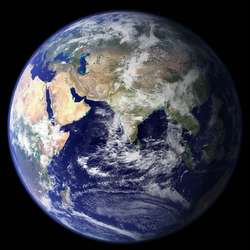
With the "Snowball Earth" hypothesis, scientists have proposed that our planet was once encased under a thick layer of ice and snow. Life could only survive huddled around hot vents deep under water. But now scientists have found fossil evidence of creatures that lived during this period, but were photosynthesizing. This means they needed to live under thin enough ice for sunlight to get through. It's possible that the entire planet wasn't encased in ice, instead there were large patches of thin ice, or even open water near the equator.
Continue reading
The European Southern Observatory's Very Large Telescope took this incredible image of galaxy NGC 1350, which is located 85 million light years away in the Fornax constellation. Astronomers classify it as an Sa(r) type galaxy, which means it's a barred spiral with two central regions. It is 130,000 light years across, so it's a little larger than our own Milky Way.
Continue reading
Continue reading
A supernova that exploded 41,000 years ago might have led to the extinction of mammoths, according to researchers at Berkeley Lab. They found ancient mammoth bones peppered with iron-rich grains that had been traveling at 10,000 km/second. These grains might have been emitted from a supernova that exploded about 250 light-years away from Earth. It's also possible that debris from the supernova coalesced into comet-like objects; one could have struck the earth about 13,000 years ago.
Continue reading
The latest images released from the Hubble Space Telescope pinpoint an enormous galaxy located almost 13 billion light-years away - at a time when the Universe was only 800 million years old. This galaxy contains 8 times the mass of stars as the Milky Way, and really shouldn't exist according to current astronomical theories. This research demonstrates that mature stars and large galaxies formed much earlier than astronomers had ever expected.
Continue reading
Paul Mayo captured this photograph of NGC 253 from his backyard observatory in Newcastle Australia. Paul used a Canon EOS 300D to take 7 separate images with his 0.3 metre telescope. You can see more of Paul's amazing photos at his
website.
Do you have photos you'd like to share? Post them to the
Universe Today astrophotography forum or
email them to me directly, and I might feature one in Universe Today.
Continue reading
NASA's New Horizons spacecraft has arrived at Florida's Cape Canaveral to be prepared for launch. If all goes well, New Horizons will lift off atop an Atlas V rocket on January 11, 2006, and begin the decade-long journey to Pluto. It's equipped with seven scientific instruments, and will study Pluto and its moon Charon during a relatively brief flyby. The mission may even be extended, giving the spacecraft an opportunity to study additional objects in the region.
Continue reading
ESA engineers have figured out how to extend the life of SMART-1's ion engine, giving the mission more time to orbit the Moon. The mission was originally supposed to end in May 2006, but by conserving fuel and changing the way it engine operates, the engineers have pushed its demise back to July 2006. SMART-1 is completely out of fuel now, though, and will coast until its decaying orbit smashes it into the Moon.
Continue reading
Greetings, fellow SkyWatchers! Ah, yes. Dark skies are ours again and we'll begin the week with the magnificent M2. There will be plenty of galactic action as we study NGC 7331, hunt down Stephan's Quintet, and relax in the stellar swarm of M34. For early risers, the sky offers some splendid scenery as two planets join two visible open clusters. But dark skies always mean just a little more, don't they? Then think Caldwell 44 and 43 as you open your eyes to the skies, because...
Because here's what's up!
Continue reading
Shahriar Davoodian took this cool picture of the Dumbell Nebula (M27) from Damavand, Iran. He used a Canon EOS 300D attached to a Meade LX90 8" Telescope with a 4 minute exposure.
Do you have photos you'd like to share? Post them to the
Universe Today astrophotography forum or
email them to me directly, and I might feature one in Universe Today.
Continue reading
That which was old is new again. The Moon, once thought a 'fait accompli', is now firmly back in the centre of many people's targets. We have to thank George W. Bush in giving his recent directive to NASA. This, together with NASA's announcement on how they plan to return to the moon, seems to indicate a golden lunar age has returned. You'd think smiles would be positively radiant at the recent seventh meeting of the International Lunar Exploration and Utilization Working Group, held from September 18-23 in Toronto, Ontario. Yes, many smiles enlivened the group. However, these smiles weren't like that of the child holding a cookie but like those of wise parents checking the list of ingredients. For this cookie has come before but disappeared all too quickly.
Continue reading
Instead of waiting for asteroids to slam into the Earth, the European Space Agency is working on a mission that will reach out and try to shift a space rock's orbit. The mission is called Don Quijote, and it will consist of two spacecraft: an orbiter and an impactor; similar to NASA's Deep Impact. The Sancho orbiter will rendezvous with a target asteroid and carefully calculate its orbit before and after the Hidalgo impactor slams into it. The ESA has chosen two candidate asteroids as potential targets, and will make a final decision in 2007.
Continue reading
A Boeing Delta II rocket successfully launched the first of a new class of modernized Block IIR global positioning system satellites early Monday morning. The rocked lifted off from Space Launch Complex 17A at 0337 GMT (11:37 pm EDT Sunday) from the Cape Canaveral Air Force Station in Florida. This new class of GPS satellites will broadcast additional signals to improve civilian and military accuracy, and prevent any jamming attempts.
Continue reading
Researchers answer their true calling by flinging themself headlong into discovering and perhaps add a little more to humanity's collective knowledge. Their friends, sleep and even food get deleted to a secondary role as just one more lead, one more calculation or one more experiment could endow understanding. The cost for a researcher in answering this call might be years of personal neglect, even though society benefits greatly. Marcelo Gleiser in his book
The Dancing Universe takes us through the history of physics from the gods of yesteryear to the cosmologists of today. He focuses on some of the really productive researchers and, in so doing, gives us a clearer understanding of physics, people and our society.
Joe Cahak captured this beautiful photograph of light from the setting Sun glinting off the launch trail left by yesterday's Minotaur rocket from Vandenberg Air Force Base.
Do you have photos you'd like to share? Post them to the
Universe Today astrophotography forum or
email them to me directly, and I might feature one in Universe Today.
Continue reading
The European Space Agency's Envisat satellite took this photo of Hurricane Rita on September 22, 2005 as it was passing Southern Florida. Envisat can use its radar instruments to peer through a hurricane's clouds and measure the roughness of the ocean beneath it. This is how scientists can estimate the wind speed of the storm at various points. Rita is expected to slam into Texas or Louisiana early Saturday morning.
Continue reading
 Universe Today