 Universe Today
Mimas and Saturn
This is a photograph of Saturn's icy moon Mimas, perched in front of the ringed planet. Mimas is only 397 kilometers (247 miles) across, so it's absolutely dwarfed by Saturn in the background. NASA's Cassini spacecraft took this photograph on January 20, when it was approximately 1.4 million kilometers (900,000 miles) from Mimas.
Continue reading
Block Starlight to See Planets
University of Arizona researchers have developed an "optical vortex mask" that will block the starlight from a bright star, so that dim objects nearby the star can be observed. This mask could theoretically be attached to a powerful observatory, to completely mask the light from the star, and allow astronomers to see planets 10 billion times less bright. Future space missions, like the Terrestrial Planet Finder might use a similar technique as well.
Continue reading
CryoSat-2 Will be Constructed
Officials at the European Space Agency have approved a plan to build and launch a replacement spacecraft for destroyed CryoSat satellite. CryoSat 1 was lost when its Rockot launcher malfunctioned on October 8, 2005. CryoSat-2 will have the same mission objectives as its predecessor, to monitor the thickness of land and sea ice, and to help scientists predict future climates as this ice melts and the planet warms up. It will probably be launched in March, 2009.
Continue reading
What's Inside a Gas Giant?
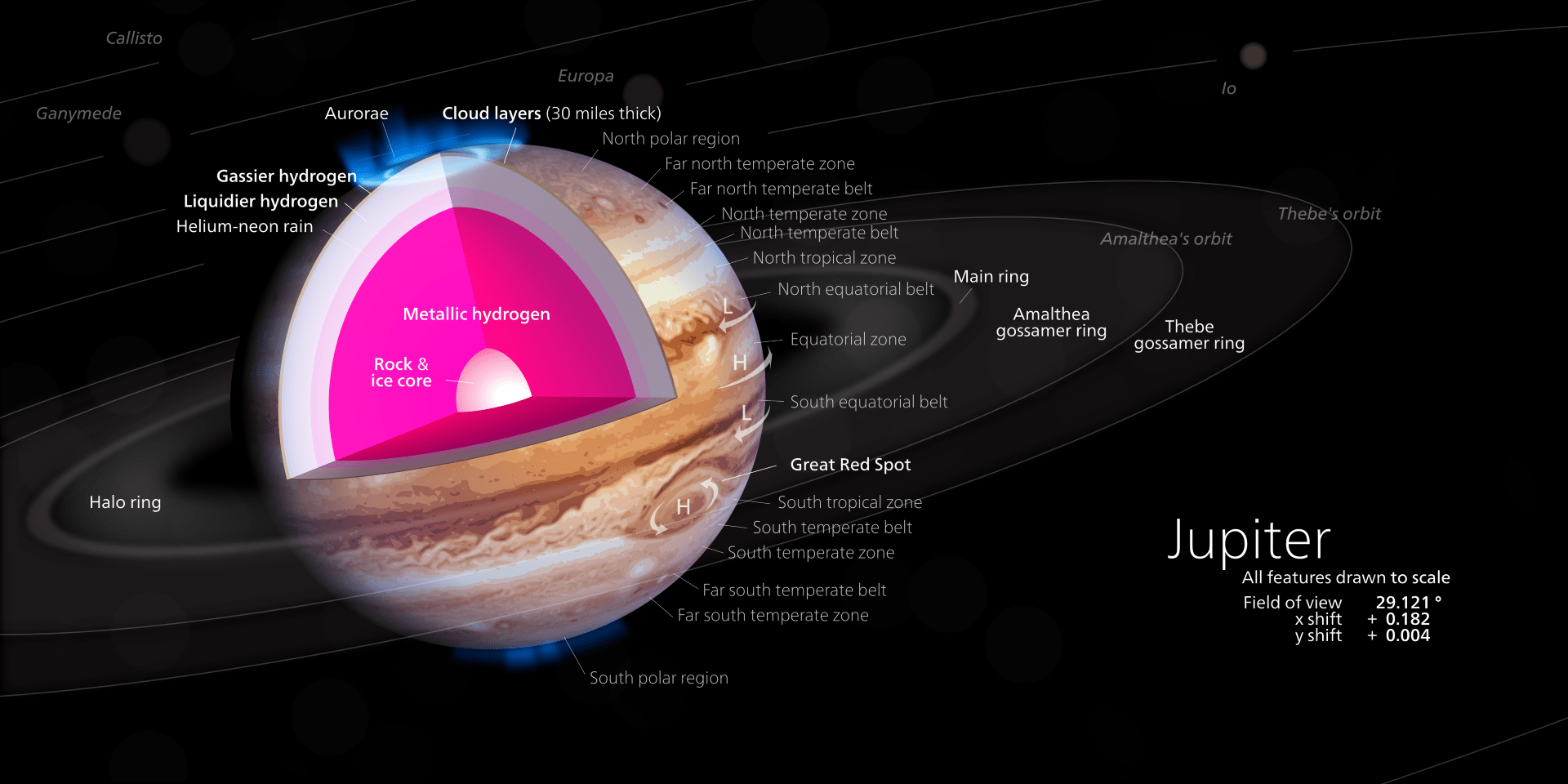
If you could strip away all the gas from Jupiter and Saturn, what would you find inside? Inside gas giant planets, the pressures and temperatures are enormous, and not much can survive those conditions. Researchers at the University of Minnesota have calculated that crystals would dissolve, and would actually work like metals, facilitating the flow of electrons. This could help to explain the tremendous magnetic fields detected around gas giant planets.
Continue reading
FUSE Satellite is Working Again
NASA's Far Ultraviolet Spectroscopic Explorer (FUSE) astronomy satellite has returned to service after being offline for about 10 months. 3 of the spacecraft's 4 reaction wheels had failed; these allow it to point at precise locations in the sky. Even though it only has a single reaction wheel, engineers were able to create a technique which allows it to orient itself. FUSE has already had its original 3-year mission extended twice, so any further science it can gather is a bonus.
Continue reading
Astrophoto: A New Star in Ophiucus by John Chumack
A pair of stars with about the same mass will evolve in about the same manner. But if one of the pair is more massive than the other, the more massive star will use its nuclear fuel faster, enter the red giant stage sooner and become a white dwarf earlier while its partner is still red and bloated. This scenario is actually quite common throughout the universe and leads to spectacular results.
Continue reading
What's Up This Week - February 27 - March 5, 2006
Greetings, fellow SkyWatchers! Start your week out "hot" as we take a look at AE Aurigae - The Flaming Star. If you still carry a torch for an old "Flame" then come along as we have a look at NGC 2024. We'll round up the horses, head out for Abell 426, lasso some wild star clusters and ride off into the moonrise as the week ends. All you have to do is turn an eye to the sky, because...
Here's what's up!
Continue reading
Here's what's up!
NASA's Orbiter is Almost at Mars
NASA's Mars Reconnaissance Orbiter has nearly reached its destination, but its work is just about to begin. On March 10, the spacecraft will turn on its thrusters, allowing it to be captured by Mars' gravity. Over the course of the next six months, it will continue adjusting its orbit through a process called aerobraking, where the spacecraft skims through the Martian atmosphere, slowing it down a little bit each time. In addition to the high resolution images and scientific data it will capture, the spacecraft will help the rovers and future landers communicate back to Earth.
Continue reading
Swift Sees an Unusual Gamma Ray Burst
NASA's Swift satellite is continuing to send back surprising information about gamma ray bursts. On February 18, 2006, it discovered something completely unique; a burst that originated 440 million light-years away and lasted about 30 minutes. This event is very similar to the more common bursts that have been seen in the past; however, it was about 25 times closer, and lasted 100 times longer than a typical burst.
Continue reading
Ausonia Mensa Massif on Mars
These images, of the Ausonia Mensa massif, were taken by ESA's Mars Express spacecraft. This region is a large remnant mountain, 3,700 metres (12,100 feet) high. It's covered by several large impact craters, some of which are partially filled with sediment, and in various stages of erosion.
Continue reading
Artificial Star Shines in the Southern Sky
In late January, astronomers celebrated the creation of an artificial star in the nighttime sky. The star was created 90 km up in the atmosphere by a powerful laser projected out of the ESO's fourth 8.2m Unit Telescope of the Very Large Telescope at Cerro Paranal in Chile. This artificial star allows the telescope's adaptive optics system to compensate against the fluctuations of the Earth's atmosphere, and produce images as crisp and clear as if they were taken from space.
Continue reading
Spiral Galaxy Messier 100
If our Milky Way looked in the mirror, this is what it would probably see. This is a photograph of galaxy Messier 100, located about 60 million light-years away. It presents an intricate structure with a bright core, two large arms, and a pair of fainter spiral arms. Japanese amateur astronomer Shoji Suzuki and Italian astronomer Marco Migliardi recently discovered a Type-Ia supernova in M100 on February 4, 2006.
Continue reading
Solar Flares Altered Mars' Atmosphere
Boston University astronomers announced today that they've found evidence that solar flares change the upper Martian atmosphere. The researchers found that when X-ray bursts from the Sun reach Mars, they cause the planet's ionosphere to produce additional ions and electrons - exactly the same situation was recorded simultaneously by satellites here on Earth. The measurements were made by NASA's Mars Global Surveyor as it transmitted data back to Earth.
Continue reading
Van Allen Safe Zone Migrates
The Earth's magnetic field concentrates solar radiation into a series of regions called the Van Allen belts. Any spacecraft or astronauts passing through these regions must take precautions or be showered with radiation. But NASA scientists have learned that a "safe zone" between the belts actually moves around depending on the amount of solar activity reaching the Earth. The measurements were made using several meteorological satellites which periodically dipped into the Van Allen belts and through these safe zones.
Continue reading
The High Cost of Boots on the Moon
When President Bush announced his new Vision for Space Exploration in January 2004, he set NASA on a new course to return to the Moon, and maybe even set boots on the surface of Mars in the next few decades. Instead of a quick course change, NASA would work within a modestly increased budget to develop the new Crew Exploration Vehicle, while completing the International Space Station and retiring the Space Shuttle. Science, such as the Hubble Space Telescope, Mars rovers, and climate research wouldn't be affected.
Continue reading
Redesigning Universe Today... Again
Pluto Was Born With Its Moons
Pluto and its three moons were likely formed together when two large objects collided millions of years ago. Charon has been observed for decades, but the two new smaller moons, discovered last year, also orbit in the same plane as Charon and have a similar orbital resonance. It's even possible that Pluto has a ring system. Astronomers now believe that many Kuiper Belt Objects have multiple moons, and even higher order systems will probably be discovered in the years to come.
Continue reading
Dark Lava Floor of Crater Billy
This image of the lunar crater Billy was captured by the Advanced Moon Imaging Experiment (AMIE) on board ESA's SMART-1 spacecraft. With a diameter of 46 kilometres (29 miles), crater Billy is located on the southern fringes of the Oceanus Procellarum. The floor of Billy has been filled by basaltic lava with a very low albedo, leaving a dark surface. This image was taken on the 14th Jan. 2006, from a distance of about 1260 kilometres.
Continue reading
Nearby Exoplanet is Scorching Hot
NASA's Spitzer Space Telescope has uncovered a hot extrasolar planet orbiting a nearby star. Planet HD 189733b orbits its parent star only 63 light-years from Earth, making it the closest extrasolar planet ever detected directly. It moves in an extremely tight orbit - less than 3% of the distance from the Earth to the Sun - completing a tour around its star in just over 2 days. And it's scorching hot, reaching temperatures of 844 Celsius (about 1,551 Fahrenheit) on its surface.
Continue reading