 Universe Today
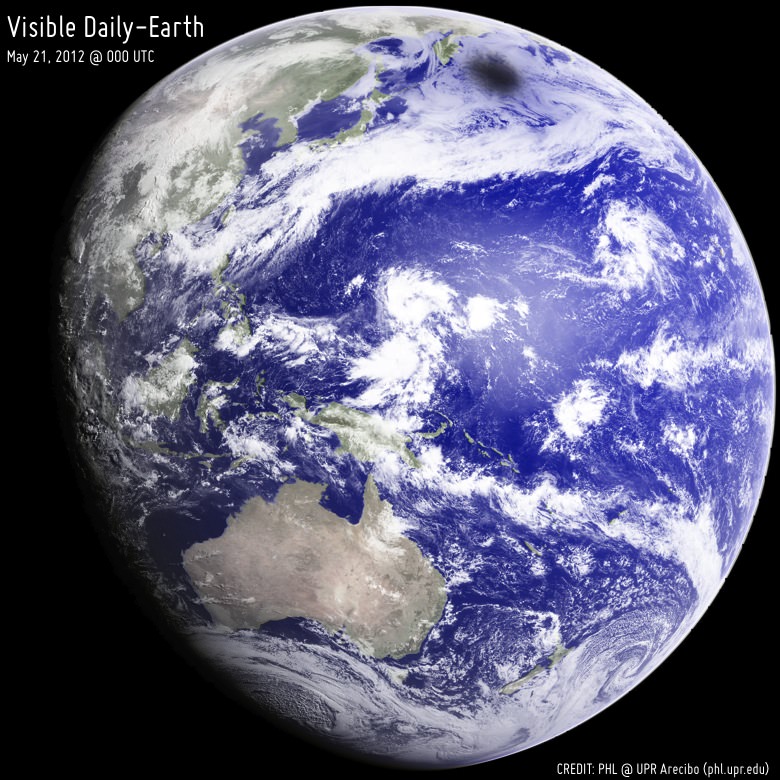
Here's a few unique vantage points of seeing the annular solar eclipse on May 20/21 2012. Above, one of the geostationary satellites called MTSAT (Multi-Functional Transport Satellite) built by Japan was able to capture the shadow over Earth near the maximum of the eclipse of May 20-21, 2012. It's rather amazing how small the shadow is! "This image was generated during a color test of our Visible Daily-Earth project," wrote Abel Mendez Torres on the PHL@UPR Arecibo website "and was taken by the MTSAT on May 21, 2012 @ 000 UTC (May 20, 2012 @ 8:00 PM EDT). Color correction was based on NASA Visible Earth datasets." The Planetary Habitability Laboratory (PHL) is a research and educational virtual laboratory that studies of the habitability of Earth, the Solar System, and extrasolar planets, and @ProfAbelMendez is a very interesting person to follow on Twitter.
Below are a couple of videos: even though you are not supposed to look directly at the Sun during an eclipse, the PROBA-2 satellite did with an awesome result, and astronaut Don Pettit's exceptional view of the eclipse from the International Space Station, as well as a view from the Hinode and Terra satellites:
ESA's space weather microsatellite Proba-2 observed the solar eclipse on the evening of May 20, 2012. It passed through the Moon's shadow a total of four times, imaging a sequence of partial solar eclipses in the process. The first contact was made on Sunday May 20 at 21:09 GMT. The last contact finished at 03:04 GMT.
Don Pettit's view:
Also, the JAXA/NASA Hinode mission captured this video of the eclipse.
Here's a view of the eclipse over the North Pacific Ocean as see by the Terra satellite:
Credit: NASA/GSFC/Jeff Schmaltz/MODIS Land Rapid Response Team
Make sure you check out our gallery of eclipse images from around the world, too!