 Universe Today
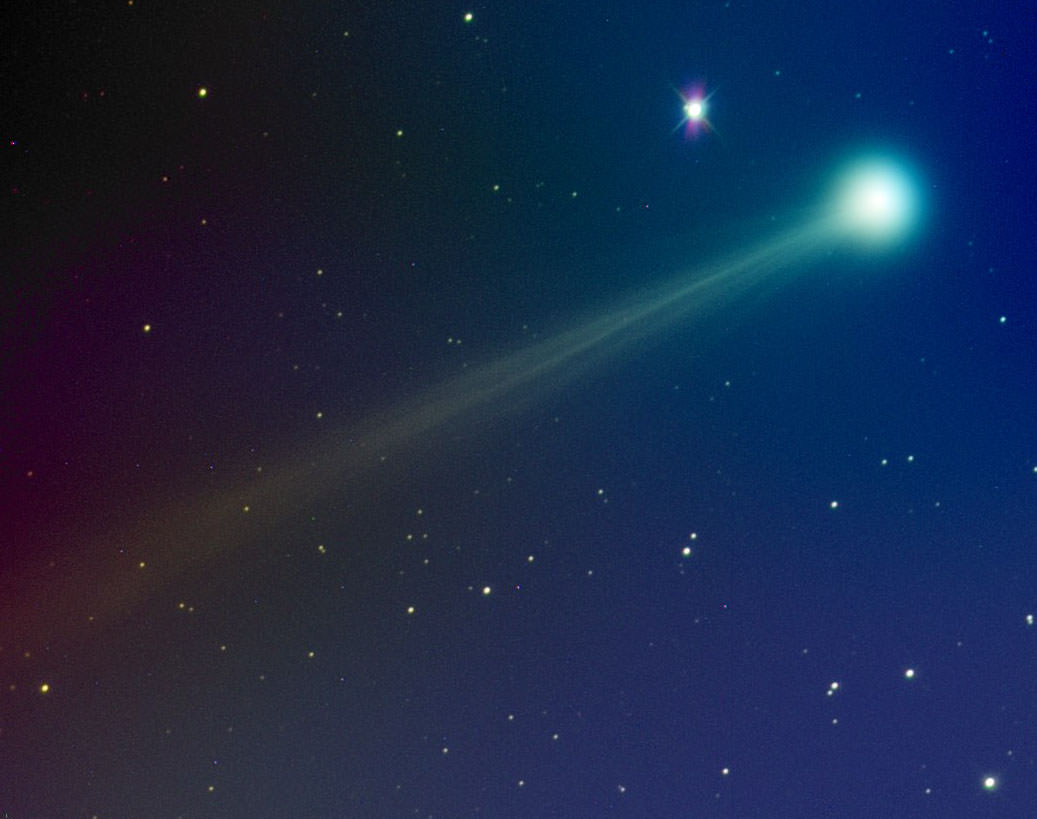
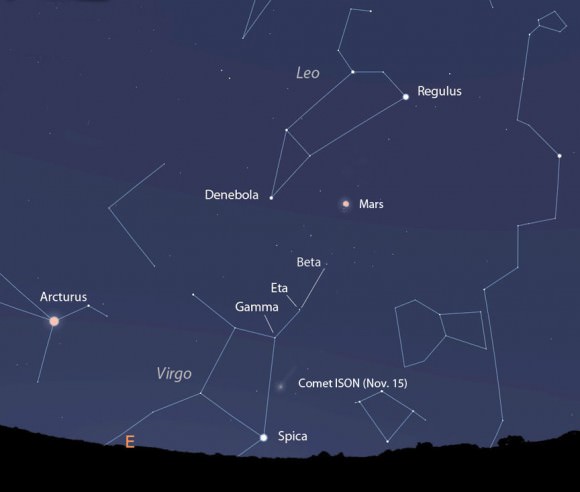
After a sleepy week, Comet ISON is suddenly coming alive. Several amateur astronomers and at least one professional astronomers are reporting today that the comet has brightened at least a full magnitude overnight. Two days ago it glowed at around magnitude 7.5 and was visible weakly in 10x50 binoculars from a dark sky. Now it's surged to around magnitude 5.5 - just above the naked eye limit - and continues to brighten. Several amateur astronomers have even seen it without optical aid.
ISON's appearance has radically changed too. A week ago the comet developed a second gas or ion tail streaming alongside the wider, brighter dust tail. That new appendage has since grown like Pinocchio's nose to nearly equal the length of the dust tail. I spotted it with averted vision Tuesday morning Nov. 12 through a 15-inch (37 cm) telescope. More exciting, the ISON's head has been much brighter and more compact. Astronomers rate a comet's degree of condensation or "DC" on a scale of 0 to 9 from extremely diffuse with no brightening in the center to disk-like or stellar. In recent days, Comet ISON has been packing it in at DC=6 or moderately compact and bright. Now amateurs are reporting that the comet's head has brightened and become much more compact with a DC of 8.
Backing up reports of the outburst, astronomer Emmanuel Jehin of the TRAPPIST (TRAnsiting Planets and PlanetesImals Small Telescope) team, noted a tenfold increase in dust production around the comet's nucleus on Nov. 11 and 12 plus additional jets of material blasting into the coma. Jehin reports that the inner coma near the nucleus is still very sharp and shows no sign of disruption - so far, ISON's hanging in there.
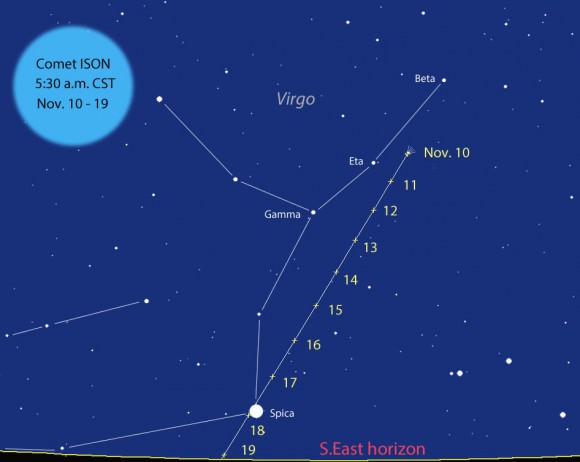
This is all great news for comet observers. The intense heat of the sun is beginning to boil away the comet's ice with greater fury. The heat may also be exposing new cracks or breaks in ISON's crust. Fresh ice means even more material becomes available for the sun to vaporize and likely additional jumps in brightness in the next day or two.